The Source Code of Reality: Open-Sourcing the KB-Flux OS
Why Physics is Just a User Interface, and the Blueprint for True AGI

Welcome to the Terminal.
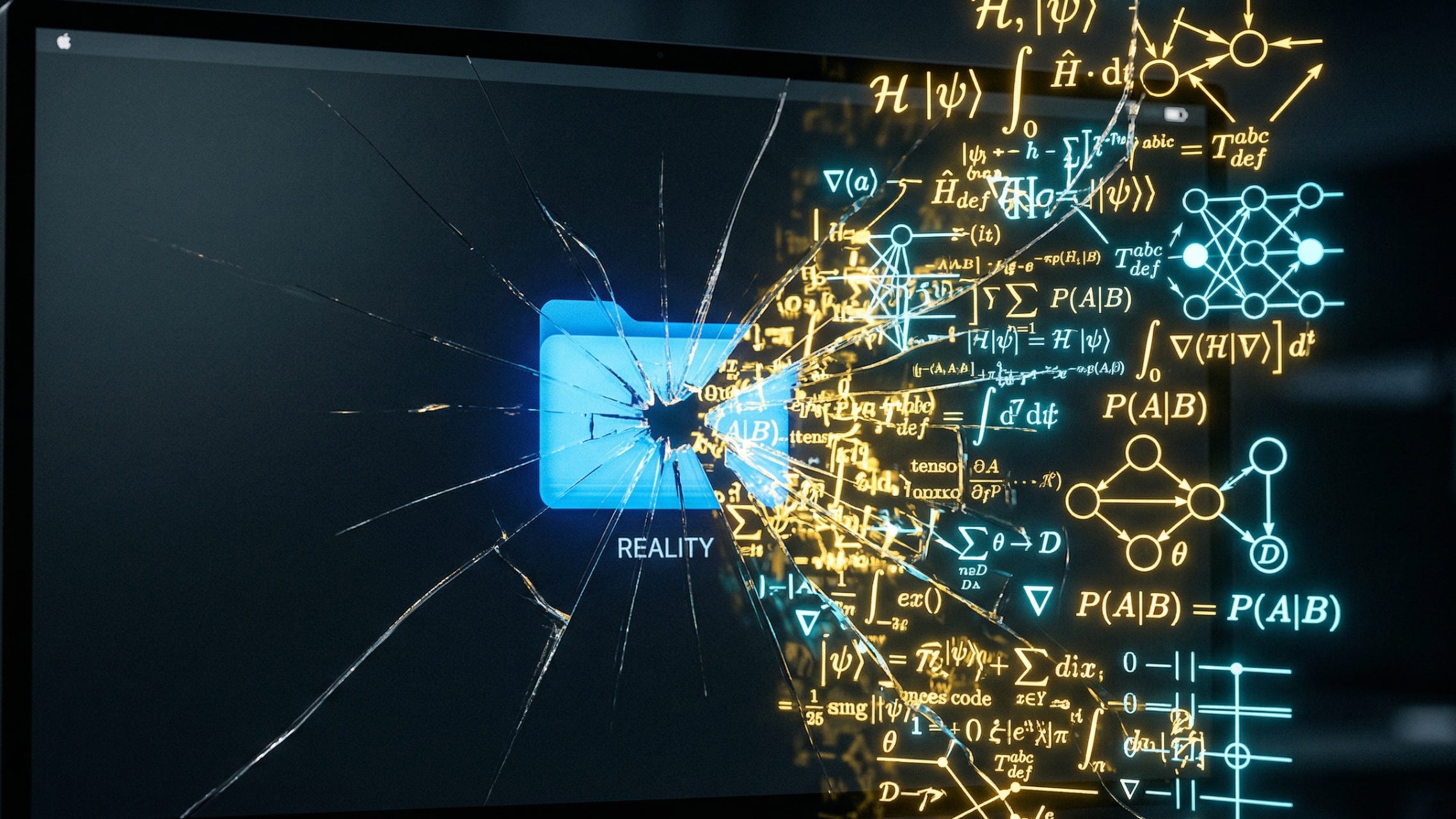
Imagine you are writing an email on your laptop. You drag a blue folder icon across the desktop and drop it into the trash.
Did you actually move a physical blue square? No. You manipulated a vastly complex, high-speed flow of voltages across billions of microscopic transistors. But if you had to consciously calculate every voltage flip just to delete a file, you would never get any work done. The “blue folder” is a necessary illusion—a compression artifact created by the operating system to make a chaotic hardware environment survivable.
Now, look around you. The chair you are sitting on, the linear flow of time, the solid objects in your room.
What if I told you that is just your brain’s desktop interface?
For the better part of a century, Quantum Mechanics has been treated as a series of spooky paradoxes. We are told of particles that exhibit non-local correlations across vast distances, and observation altering reality. The scientific community has tied itself into metaphysical knots—conjuring infinite parallel universes—just to preserve the comforting idea that the universe is made of static, enduring “stuff.”
They are trying to debug the software by staring at the monitor.
My name is Tim Shum. I am a macro-systems architect and an independent researcher. In this foundation series of the Mind & Machine publication, we are going to perform a hard reset on how you understand existence.
We are not the first to notice the glitch in the matrix. Brilliant pioneers like Donald Hoffman have argued that evolution hides the truth to prioritize fitness. Physicists in the QBism camp have redefined quantum states as personal degrees of belief. Karl Friston has shown us that brains are prediction engines minimizing Free Energy.
But we are going to take the final, radical step. We are going to invert the causal arrow. Physics is not the substrate that creates the mind; physics is the rendered output of optimal Bayesian inference. We call this unified computational architecture The Kantian-Bayesian Flux (KB-Flux).
The Stakes: Why This Changes Everything
If this framework holds, the implications ripple far beyond academic physics. The measurement problem, the hard problem of consciousness, and the unification of quantum mechanics and gravity may all be symptoms of the exact same error: treating the rendering as the reality.
This is not just armchair philosophy. It is an urgent engineering blueprint.
Right now, the most advanced Artificial Intelligence labs in the world are hitting the scaling walls of Large Language Models. In their race to build true Artificial General Intelligence (AGI), they are unknowingly converging on the exact architecture of the KB-Flux framework.
From Yann LeCun’s push for “World Models” to the deployment of Active Inference in robotics, engineers are discovering a fundamental truth: Object permanence and causality cannot be hardcoded. They must naturally emerge when an agent is forced to minimize prediction errors (Free Energy) in a chaotic, partially observable environment.
Silicon Valley is currently building the very “Belief States” that Immanuel Kant and Bayes predicted centuries ago. If we don’t understand the operating system of reality, we risk building AGIs that render a physics entirely alien to our own.
The Roadmap: What to Expect in This Series
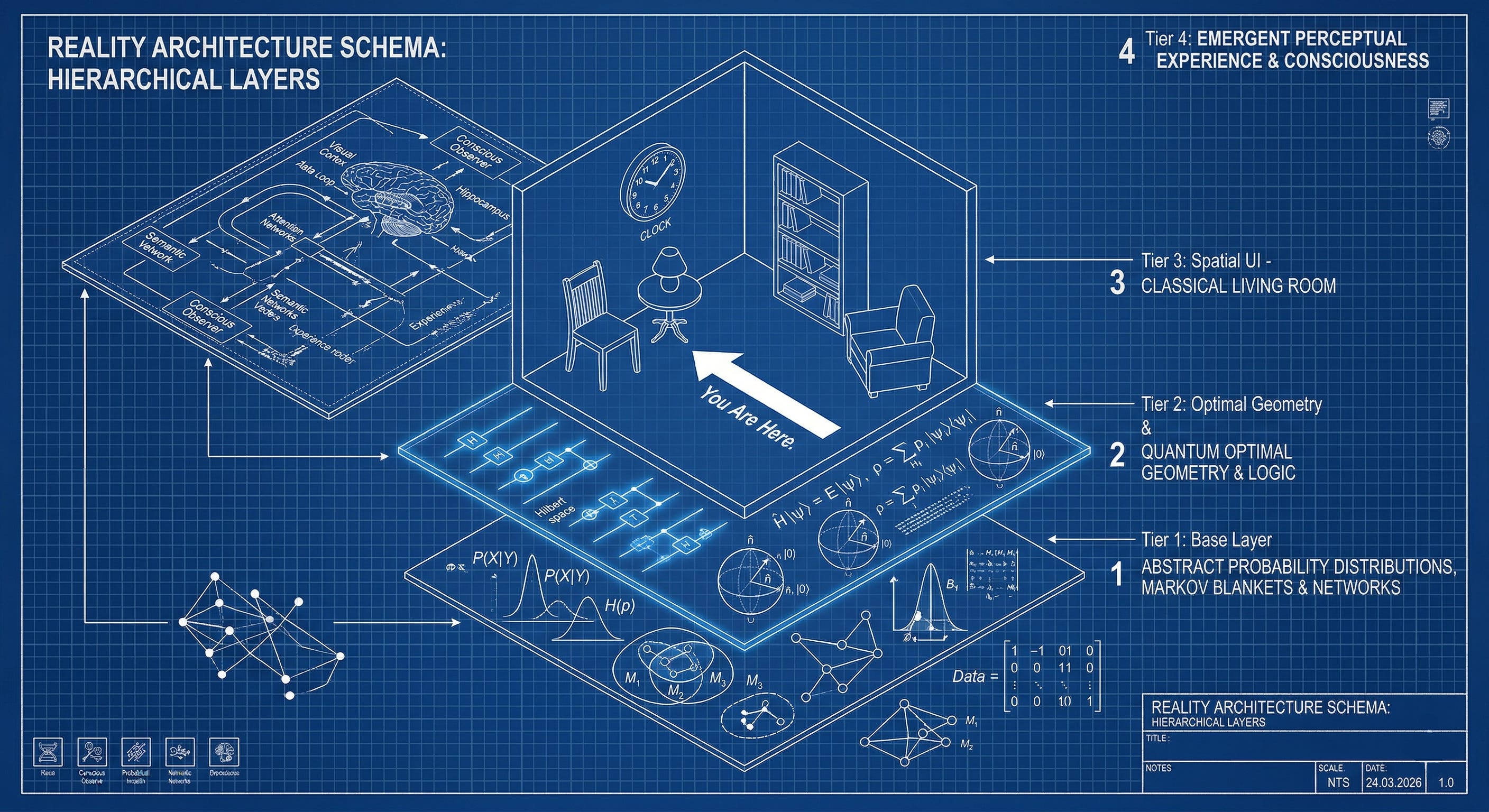
Over the coming weeks, we will open-source this operating system module by module. We will break down the KB-Flux architecture into a 4-phase Foundation Series:
Phase 1: The Setup (Articles 1-3). We will establish the core premise. We will explore the “Reality as a Dashboard” metaphor and introduce the Free Energy Principle. Finally, we will execute the ultimate pivot: What if prediction goes all the way down?
Phase 2: The Architecture (Articles 4-6). We will reveal the “Three Floors of Reality.” To ensure we don’t lose you in the math, we will build a minimal computational “Toy Model”—a simple 2-state inference agent. Rather than relying on tedious academic proofs, we will run the thought experiment to reveal exactly why the bizarre rules of quantum mechanics (superposition, Born rule) are not laws of matter, but the inevitable geometry of optimal inference.
Phase 3: Payoffs (Articles 7-9). We will use this new OS to debug legacy physics. We will dissolve quantum entanglement (showing it is just “Pointer Aliasing” in the UI) and explore how gravity emerges as an entropic inference.
Phase 4: Frontiers & The Kill Switch (Articles 10-12). We will explore the implications for AGI, and publish the open computational and mathematical bounties of this framework—inviting AI engineers, physicists, and hackers to run the simulations and prove the theorems. Crucially, we will lay out the explicit Falsification Conditions. Because any framework that cannot be killed is not science. It is mythology.
The static world you thought you knew is a compression artifact. Reality is a river of data, and your mind is an optimal inference engine fighting to maintain its shape.
Subscribe, and prepare to update your priors. We are about to recompile reality from the kernel up.